Now I Can See It All
The Fate of Ophelia sent me down a rabbit hole of myths about love.

Let me begin by saying that I am not a fan of Taylor Swift. I haven’t heard enough of her songs or followed her public and personal life to find any attachment to her music or persona. But I am a music lover and I have listened to some of her songs. But this post is about her latest song, “The Fate of Ophelia”, from her album, “The Life of a Showgirl”. I discovered it on an Instagram reel and then one thing led to another and it ended up in my list of liked songs. I usually listen to the song many times before I watch their video or dig deeper into the lyrics because I don’t want the latter to influence my judgement of a song. For me, a song becomes loved when it is felt in my body. The goosebumps, the shift in mood, the change in body language - these are some of the signs that make me go, “Okay, this is good. Now let me pay more attention to it.”
So I allowed myself to finally watch the video and realized that this was definitely loaded with a lot of imagery and symbolism that are clues that Swift leaves for her fans to make sense of. And there is enough and more about that on the internet. But here’s what intrigued me the most. The words.
Who was Ophelia and what was her fate? I needed to understand this before I could understand how one was saved from it. I found out that Swift is referring to Ophelia’s character from William Shakespeare’s play Hamlet. Hamlet was published around 1599-1601 and was set in medieval Denmark. Ophelia was a noblewoman who was in love with Prince Hamlet. But she was always torn between her love for him and her allegiance to her father, Polonius and her brother Laertes. Since Prince Hamlet is the heir to the throne of Denmark, Laertes suspects that he would not be allowed to marry just anyone, and warns his sister about this. This for me, sets up the narrative of doomed love in this story. Hamlet is not able to reciprocate Ophelia’s love and she is left confused between what her heart wants and what the reality is. In this environment, the death of her father at the hands of the man she loves, drives her into madness. Eventually, she dies by drowning in a brook. Her death becomes a topic of debate as some consider it an accident, while others claim that it was suicide. The biggest tragedy was that Queen Gertrude, Hamlet’s mother, while sprinkling flowers on her grave says she wished Ophelia had been Hamlet’s wife, proving Laertes’ claim false. And Hamlet, still alive, finally declares that he loves Ophelia more than forty - thousand brothers could.
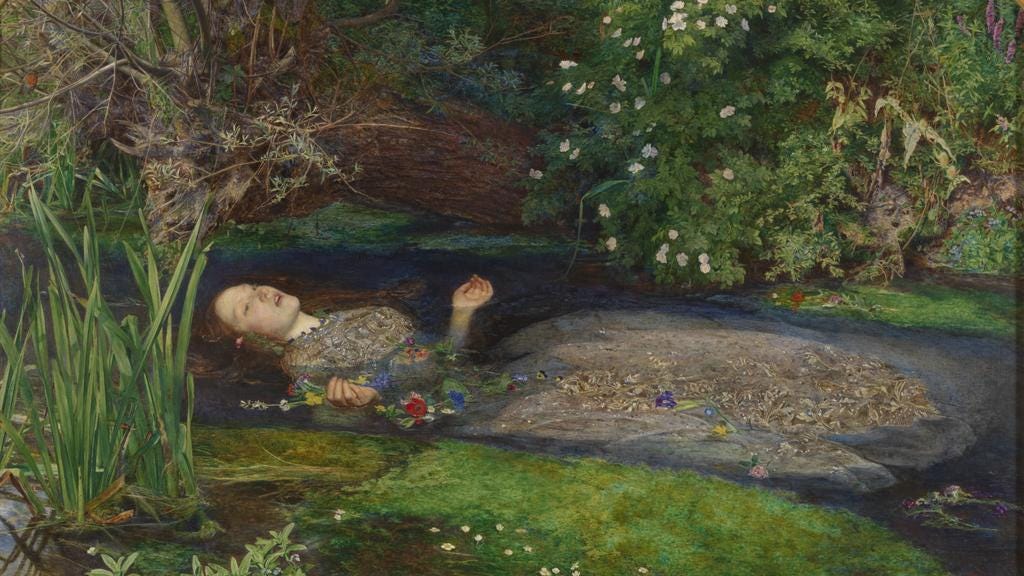
I could relate this to the Seven Stages of Love in Sufism. These seven stages are - Dilkashi (attraction), Uns (infatuation), Mohabbat (love), Aqeedat (faith/reverence), Ibadat (worship), Junoon (madness), and Maut (death). I couldn’t help but see the parallels between these stages and the stages of Ophelia’s journey, a very lonely journey in love. Do you think Shakespeare was aware of the seven stages of love? Or was there something more universal, archetypally human at play in this unfolding? Whatever it was, this was the fate of Ophelia. While in Sufism, these seven stages refer to steps that lead to annihilation of the ego and union with the divine, for Ophelia, this was a case of unrequited human love. And I am curious to understand if there is some glorification of this kind of love that is one - sided and sacrifices the individual ( an often weak and seemingly insignificant female) in the face of social expectations and familial allegiance.
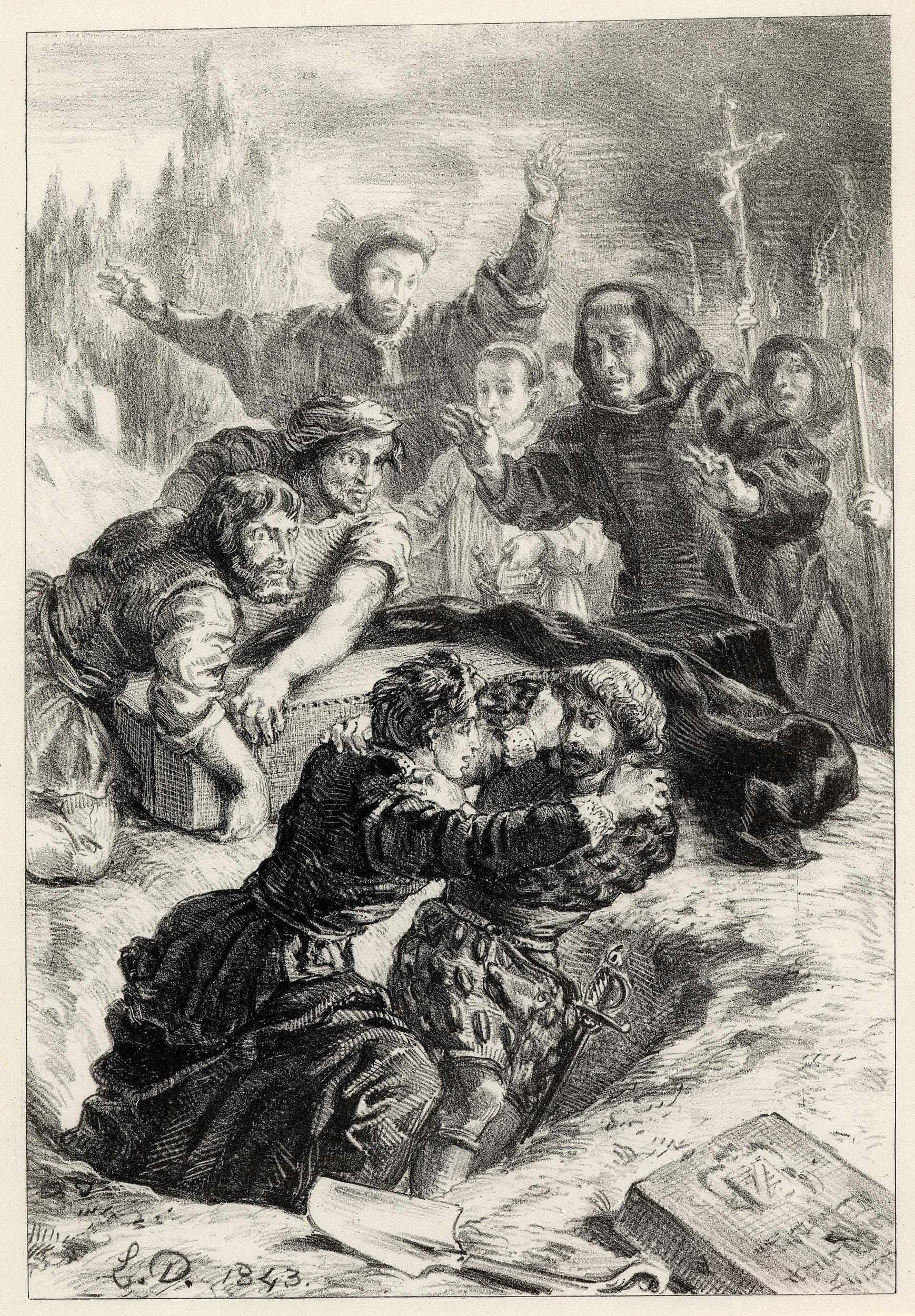
But keeping all that aside, let’s come to the man in the story. Mr. Hamlet. Yeah, I know he was a prince but I don’t feel like calling him that. To be fair, I must address my concern to his creator, William Shakespeare. I wonder why he had to be so heartless in his treatment of Ophelia. And then again, I wonder, if this too is drawing from some form of masculine archetype - a man too troubled by the world, to focus on love and emotions. Too consumed by his pain and sadness to focus on others. Too disoriented and disillusioned to receive the very thing that he needs the most. Love. And too late to realize all of this.
Let’s come back to 2025. Taylor Swift and Travis Kelce announced their engagement earlier this year and it was celebrated all over the internet. Why? Because Swift has had a series of difficult relationships and finally found a man who gave her what the world says she deserves. I am aware that a lot of her songs draw from her own experiences in love and relationships. So when I heard The Fate of Ophelia, I thought this was a song about Travis Kelce. But then I came across something else.

I discovered a video that featured Maureen Murdock’s book, The Heroine’s Journey. When Murdock approached Joseph Campbell with her proposition about the Heroine’s Journey, his response was, “In the whole mythological tradition the woman is there. All she has to do is realize that she’s the place that people are trying to get to. When a woman realizes what her wonderful character is, she’s not going to get messed up with the notion of being a pseudo-male.” Murdock was dissatisfied with this view and went on to chart a new journey that would situate the woman as a main character on a quest of her own. Murdock is trained in Jungian psychology and drawing from Carl Jung’s work arrives at a different end to the journey, where the heroine is in an inner union with all parts of herself, where she is her own savior, her own lover and her own companion. The men, in this story, have been reconciled with at an earlier stage and are not the end, the prize or the goal of the heroine’s journey.
I am not sure if Taylor Swift is aware of this and whether she based her song on this, but I cannot help up re-read her song with this lens. According to my new found understanding, the “you” and “me” in the lyrics can refer to different parts of the woman’s psyche - the conscious and the unconscious, the public and the personal, the outer and the inner, the masculine and the feminine. And in this integration of parts, she is able to save herself from the fate of Ophelia, which, in very simplistic terms, means the end of her existence.
In this way, the song isn’t just about a happy ending leading to a man who saved a woman, but about a woman saving herself by honing our powers and digging herself out of the graves that she may have slipped into. I would like to believe that Taylor Swift has done this for herself too. But are we ready to really accept this interpretation, this theory? What would happen to romantic love if women were to write and sing love songs about their own selves?
I am going to say that I am hopeful that romantic love is on its way out and this is how the end begins. There has been some discussion in public discourse about how romantic love is as much biologically driven as it is socially constructed and ironically it is through popular culture that we ingest this narrative. And maybe it is through popular culture that we will eventually free ourselves from its limitations.
So deeply you have thought, Parool, to connect so many different thought processes across times and borders - from Shakespeare to Taylor Swift!!🩷😊
Very interesting read, Parool. Haven’t listened to this song or album yet. Will check it out. And this is the second or third mention of the Murdock book I have come across in the last one week. A sign from the universe to buy the book, I think :)